

This story appeared on Network World Fusion at http://www.nwfusion.com/news/1999/0329oldgear.html.
By TIM GREENE
Network World, 03/29/99
Keeping antiquated technology flying is in Chris Harrison's blood. A pilot and former reseller of airplane parts, Harrison is proud of the fact that he uses old and even salvaged hardware to run his company's network. Phoenix Communications Services, the Internet access and paging company he owns in Dallas, uses a server he got for free and a PBX he bought at auction for $250.
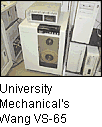 Y2K, though, is the end of the road for other gear, including a Wang VS-65 that cost $250,000 in 1984 and is still in use at University Mechanical Contractors in Seattle. Once the anchor of the company's accounting system, the VS-65's specifications are unimpressive by today's standards: 1,024K bytes of RAM and 2G bytes of fixed storage. It has 8mm and 1/2-inch reel-to-reel tape backups.
As a result, the VS-65 isn't asked to do much anymore, says Chris Bondelid, a systems administrator for University Mechanical.
"We still have it operating for legacy accounting info lookups, but it's mainly burning electrons, twiddling its thumbs. It's slower than molasses in January," he says.
But it is a known system, it is paid for and it still meets the needs of the records-lookup application.
"It has been solid as a rock," Bondelid says.
Plus it has entertainment value. "All my friends that come over look at it and their eyes bug out," he says.
But soon it will be decommissioned. "It supports an old COBOL application that would be too hard and costly to make Y2K-compliant," Bondelid says.
What will happen to the VS-65? "We're possibly thinking of asking Wang if they want it back for testing or training purposes," Bondelid says with a smile.
Y2K is claiming other workhorses, including the 1992 Cisco IGS router blade in a Cabletron MMAC-3 hub that until earlier this year provided remote access to a branch office of the National Cancer Institute in Fort Detrick, Md.
Earlier this year, the router was still running Cisco's IOS 8.3(3); Cisco is currently shipping IOS 12.
Since the hub/router combination was installed, Cisco and Cabletron stopped doing business with each other.
"This was from the two vendors' friendlier days," says Tom Zanylo, a network analyst for Science Applications International, which administers the cancer institute's network.
But the MMAC-3 wasn't broke, so nobody thought to fix it, Zanylo says. However, Cisco says it won't support the router after 2000. So the institute traded it in during a network upgrade from a shared Ethernet to a switched Ethernet LAN.
While some network executives tolerate old gear until it is forced into retirement, others actively weed it out.
The U.S. Department of Education, for example, is in the midst of upgrading its Student Financial Assistance Program network from SNA to TCP/IP, says Tim Weil, a network consultant working on the project for RPM Consulting of Columbia, Md.
ZIP!SNA Gateways from Attachmate, 10-year-old DOS-based devices that Attachmate no longer supports, still link the department's desktops to its mainframes. The gateways are showing their age.
"When you walk down the hall and open the cabinet, you can just rub the dust off the top of the things. Whenever I look, there's a fingerprint from the last guy who was there," Weil says.
The fact that the gateways still work won't save them.
"The motivation for going forward isn't that it doesn't work. It all works. The desire to get into a complete TCP/IP architecture is, well, we want to get into the 20th century before it's over," Weil says.
Y2K, though, is the end of the road for other gear, including a Wang VS-65 that cost $250,000 in 1984 and is still in use at University Mechanical Contractors in Seattle. Once the anchor of the company's accounting system, the VS-65's specifications are unimpressive by today's standards: 1,024K bytes of RAM and 2G bytes of fixed storage. It has 8mm and 1/2-inch reel-to-reel tape backups.
As a result, the VS-65 isn't asked to do much anymore, says Chris Bondelid, a systems administrator for University Mechanical.
"We still have it operating for legacy accounting info lookups, but it's mainly burning electrons, twiddling its thumbs. It's slower than molasses in January," he says.
But it is a known system, it is paid for and it still meets the needs of the records-lookup application.
"It has been solid as a rock," Bondelid says.
Plus it has entertainment value. "All my friends that come over look at it and their eyes bug out," he says.
But soon it will be decommissioned. "It supports an old COBOL application that would be too hard and costly to make Y2K-compliant," Bondelid says.
What will happen to the VS-65? "We're possibly thinking of asking Wang if they want it back for testing or training purposes," Bondelid says with a smile.
Y2K is claiming other workhorses, including the 1992 Cisco IGS router blade in a Cabletron MMAC-3 hub that until earlier this year provided remote access to a branch office of the National Cancer Institute in Fort Detrick, Md.
Earlier this year, the router was still running Cisco's IOS 8.3(3); Cisco is currently shipping IOS 12.
Since the hub/router combination was installed, Cisco and Cabletron stopped doing business with each other.
"This was from the two vendors' friendlier days," says Tom Zanylo, a network analyst for Science Applications International, which administers the cancer institute's network.
But the MMAC-3 wasn't broke, so nobody thought to fix it, Zanylo says. However, Cisco says it won't support the router after 2000. So the institute traded it in during a network upgrade from a shared Ethernet to a switched Ethernet LAN.
While some network executives tolerate old gear until it is forced into retirement, others actively weed it out.
The U.S. Department of Education, for example, is in the midst of upgrading its Student Financial Assistance Program network from SNA to TCP/IP, says Tim Weil, a network consultant working on the project for RPM Consulting of Columbia, Md.
ZIP!SNA Gateways from Attachmate, 10-year-old DOS-based devices that Attachmate no longer supports, still link the department's desktops to its mainframes. The gateways are showing their age.
"When you walk down the hall and open the cabinet, you can just rub the dust off the top of the things. Whenever I look, there's a fingerprint from the last guy who was there," Weil says.
The fact that the gateways still work won't save them.
"The motivation for going forward isn't that it doesn't work. It all works. The desire to get into a complete TCP/IP architecture is, well, we want to get into the 20th century before it's over," Weil says.
All contents of Network World Fusion are copyright 1995-1999 by Network World, Inc., Framingham, MA 01701.